A federal government with a strong mandate, a healthy stock market and ever booming property market are giving ongoing confidence to the Australian art market. It started well with the first round of major art sales and during this second round continues to flourish. The very positive results across all manner of art, be it colonial, impressionist, mid-20th century or contemporary, are all achieving consistently strong results in the secondary market.
Last week, we witnessed a Menzies sales result of $7.92 million (89% clearance rate), Smith & Singer with $15.88 million (79% clearance rate) and Leonard Joel with $4.55 million (85% clearance). Now we can report on Deutscher and Hackett’s similar success in Melbourne achieving $10.6 million in their typically tightly curated 52 lot offering and a clearance rate of 89%.
Australian buyers and sellers of art proceed with gusto, and we expect to see more of the same in the end of year auctions. This no doubt will entice equally important artworks from confident sellers who can fully appreciate the benefits of selling in this ebullient market.
As you would expect with any Deutscher + Hackett sale, provenance is king, and reading the history of ownership of the artworks in their catalogue can be as captivating as their thoroughly researched catalogue essays.
Freshly flown in from their previous homes in New Orleans, two jazzy and light-filled scenes of Paris interiors by Bessie Davidson both sold: Interior with Girl reading, c.1924 (Lot 1) selling at the low estimate of $150,000, and Intérieur, c.1924 (Lot 2), for $240,000, just below its expectations of $250,000-$350,000.
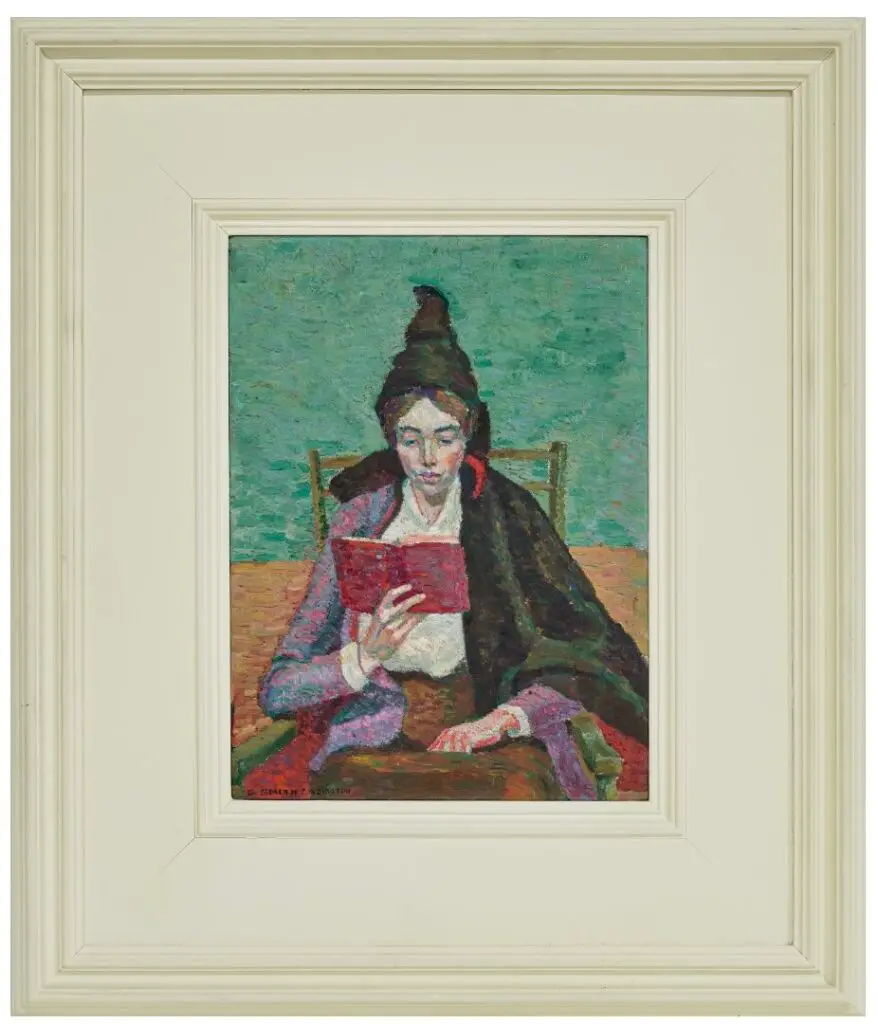
A number of significant and not so significant works by Grace Cossington Smith hit the market in the last week, including Chair and Drapery, 1958, at Smith and Singer, which sold for the second highest price for the artist. The question on everyone’s lips was whether the very much earlier and modestly sized The Reader (The School Cape), c1916, (Lot 3), measuring just 32 x 24 cm, would threaten these larger and later paintings. Director Damien Hackett was quite convinced. He did mention the magic figure of a million dollars, as her colourful modernist pictures now engage collectors with the deepest pockets, and her prices for her best paintings approach this mark including buyer’s premium.
On the night, the estimates of $400,000-$600,000 were indeed thoroughly eclipsed: after fierce bidding, The Reader sold for $800,000 hammer price, and including premium the buyer will pay $1 million, setting a new highest price for the artist. Grace Cossington Smith now joins the rarefied exclusive club of Australian women artists whose works have sold for $1 million or more at auction. Given this, it was hard to see why the also very impressive House with Golden Trees, 1937 (Lot 4), with seemingly quite justified estimates of $300,000-$400,000 failed to find a buyer on the night.
There was no such hesitation for Young Man Sleeping, c1936 (Lot 6) by our master of figurative painting William Dobell from his important London pictures. Looking like the young man was recovering from a night on the town, this perhaps highly relatable image resonated with buyers, and soon surpassed its low estimates of $180,000 and then the high hopes of $280,000 to sell eventually for $420,000. Roy de Maistre was particularly well represented in the sale with four paintings. The best results were achieved for the two typically cubist works: Two Women in a Boat, c1935 (Lot 7) pulled away for $85,000 (estimates $50,000-$70,000), whilst Woman in a Chair, c1944 (Lot 9) on a wide estimate of $120,000-$180,00 made $130,000. His more traditional depiction of a snow laden London backyard (Lot 35) failed to excite buyers and passed in on expectations of $30,000-$40,000.
As auctioneer Roger McIlroy pointedly mentioned in opening the lot for sale, John Brack’s important painting The Slicing Machine Shop, 1955 (Lot 10) was exhibited alongside Brack’s iconic Collins Street 5pm, 1955 at Peter Bray Gallery in Melbourne in 1956. On this occasion, the extensive exhibition history and literature failed to cut it with buyers in search of something more meaty for their money. With hopes of $600,000-$800,000, there was no sale on the night at least.
Albert Tucker’s colourful dramatic Betrayal, 1952 (Lot 11) clearly fit the bill for one lucky buyer, who paid $260,000, significantly less than the low estimate of $400,000. Albert Tucker’s other 1950s picture offered was being de-accessioned by one of the world’s most important museums, New York’s Museum of Modern Art (MoMA), and not the first artwork by a notable Australian artist to be de-accessioned. In June 2023, Menzies offered Fred Williams’ minimalist Upwey Landscape No. 1, 1970, with the same MoMA provenance at $60,000-$80,000, setting the then new auction record for a gouache painting by the artist, selling for $120,000.
Now selling not an Australian, but a Lunar Landscape (Lot 12), this oil painting had the same estimates of $60,000-$80,000 as the Williams. It also didn’t disappoint with the seductive provenance (although not exhibited there since April 1959) selling very comfortably above the high estimate for $135,000. Speaking of Fred Williams: the pink hues of his Burnt Hillside from 1968-69 (Lot 14) were an irresistible lure for several bidders. Arguably one of Australia’s most articulate definers of our landscape, this painting sold for exactly the high estimate of $600,000.
The strength of the market for Howard Arkley was put to a further test with the offering of New Room, 1993 (Lot 17), one of his smaller but sought after interior scenes, 173 x 135 cm, estimated at $800,000-$1,200,000.
The highest price for an Arkley interior goes all the way back to 2019, when Menzies sold Deluxe Setting, 1992, 173 x 135 cm, for $1.25 million, also on hopes of $800,000-$1,200,000. New Room was offered just a week after the larger Contemporary Units, 1988, 160 x 240.5 cm, was sold by Smith and Singer for $2 million, which equalled the Deutscher and Hackett result in May for Neapolitan Delight, 1993, 172.5 x 254 cm. With the exact same estimate as Deluxe Setting and the rather unique provenance of international uber collector Ueli Sigg to boot, this painting was destined to soar. New Room turned out to be a real room pleaser with the most determined of bidders securing the work for $1.65 million, more than twice the low estimates.
Whilst no doubt the corks would have been popping at the conclusion of the D+H sale, Brett Whiteley’s Champagne 1976 (Lot 15 ), an oil and collage on canvas which included 19 genuine champagne corks integrated to the top of the canvas, was a bit of a fizzer and failed to sell on the night, even though it was the cover lot. However, Brett Whiteley was not to be let down, as he was represented by three other strong examples of his practice. The Magpie, 1976-77 (Lot 18), once owned by Wendy Whiteley’s aunt and uncle, sold nicely for $550,000, mid-range its $450,000-$650,000 estimates.
The very next lot Startled Heron, 1984 (Lot 19) perhaps also startled the auction house as well as its vendor, as it sold for a whopping $550,000, on hopes of $350,000-$450,000. It can be challenging to determine the exact media the highly experimental Whiteley used for his works, but it certainly appears that Deutscher + Hackett achieved here the highest ever price at auction for a work on paper by this artist. Modern conservation and framing and glass technologies can preserve mixed media artworks and ensure their longevity today just as well as an oil or acrylic painting. Another work on paper, The Back of Notre Dame with Bridges, 1990 (Lot 42) sold for $46,000, just above its low estimates of $45,000.
Two modestly sized oil studies by Jeffrey Smart were very well received: Study for Approach to E.U.R., 1970 (Lot 16) hit the road at $120,000 as was driven all the way up to $230,000, $70,000 above the high estimate.
Similarly, Third Study for Portrait of Bruce Beresford, 2009 (Lot 37), estimated at $50,000-$70,000, headed in the right direction to make $85,000.
Three colonial oil paintings from 1855 and 1852 were offered by well-known goldfields painter S.T. Gill, with a provenance going all the way back to c.1879 to one Arthur H.S. Piggin, and all three handed down from generation to generation over 146 years. Collectors are often called merely custodians of important artworks, and there we have a perfect example of such stewardship. These important and rare oils, if in need of a good clean, were likely to be highly prized acquisitions by their next owner/custodian. Mt. Emu from Stockyard Hill, 1855 (Lot 30) and On the Barwon River above Fyansford, Victoria, 1855 (Lot 31) sold both well for $48,000 on expectations of $30,000-$40,000.
Meanwhile, On Rocky Creek near Fryers Creek, 1852 (Lot 32) on lower hopes of $25,000-$35,000 did not attract the same level of interest on the night and passed.
As we all know, weddings can be quite costly. The market for Mirka Mora’s character-filled pictures is at an all-time high, so her The Wedding, 1988 (Lot 45) turned out to be an expensive buy for the eventual purchaser who bid to $65,000, well above estimates of $30,000-$50,000. Albert Namatjira’s market continues to rise. Although the artist used quality materials, watercolour, his choice of medium, can and does lead to considerable fading over time. Evident here with Darwin, 1950 (Lot 47), scarcity however wins, as this is one of only a handful of works produced in this location. Given this significance, Deutscher + Hackett placed estimates accordingly at $70,000-$90,000, when a “standard” Albert Namatjira even with bright colours might attract a much more modest estimate of perhaps $30,000-$40,000. Darwin still looked too cheap to scholarly collectors and sold for a blue-sky price of $120,000.
Not an Auction Review, but an Exhibition Recommendation
The Heide Museum of Modern Art in Melbourne currently presents an exciting and timely look and comparison of two hundred images by ground-breaking photographer Man Ray with our own pioneering Max Dupain. The clever curation juxtaposes the two artists, making it an exhilarating guessing game to figure out whether one looks at a Man Ray or a Dupain, and recognising that the quality of their work is often indiscernible from each other. Much of their experimental work is exhibited, and it is somehow pleasing not to necessarily see Dupain’s best-known imagery, like for example Bondi Bathers, At Newport or Sunbaker. Nonetheless, Dupain’s Sunbaker is as iconically Australian as the Sydney Opera House. It is still surprising however that this most iconic image (Lot 52) is estimated to sell for $25,000-$35,000, and it did sell mid-range for $30,000 to a no doubt happy buyer.
There is considerable evidence that buyers are making their way back to the auction room to bid in person and enjoy the ambiance of the room against bidding by phone or via the internet. Participation rates at this round of sales have been higher than usual, and Damian Hackett tells us that they put out 80 seats and had some 30 people standing in the room. So perhaps as working from home is in decline, so is buying art from home.
Read this exclusive Auction Review also at Australian Art Sales Digest
Interested to know more about the services of Banziger Hulme Fine Art Consultants.